An exhaust hose can defeat a temporary cooling plan if the only place to route it is through a hatch that admits hot outside air. On a boat, the cabin is small, openings are exposed to weather, and every occupied corner has another purpose.
A movable air conditioner may suit a weekend alongside a dock or an intermittently used compartment, but the convenience of bringing a machine aboard is only one part of the calculation. Any realistic temporary setup must leave the occupied cabin usable after the exhaust and power connections are made.
Follow the Heat Out of the Cabin
A cooling machine does not destroy heat; it transfers heat away from the air being cooled. Many temporary, hose-vented appliances reject that heat through an exhaust duct to the outside.
If the hose empties into another enclosed locker or if its outlet draws hot air back toward the cabin, the intended cooling benefit can fall sharply. For that reason, portable marine AC arrangements depend on an exit route as much as on a quoted BTU figure.
The route needs enough room for the duct without blocking passageways or creating an unsafe opening. Its termination must also account for rain, spray and the movement of the vessel. Condensate handling and the manufacturer’s operating-clearance requirements deserve attention before a unit is placed near soft furnishings.
A route that works at the dock might be exposed to spray or become obstructed by ordinary movement aboard, so temporary fittings need a clearly defined safe operating situation. A portable machine may avoid permanent refrigeration plumbing, yet it can occupy valuable floor space throughout the period of use.
Match the Temporary Load to Available Electricity
Shore connection, a generator and a battery-backed outlet are not equivalent sources. The appliance’s rated voltage, running input and any starting requirements have to suit the circuit supplying it. Other consumers on the same circuit can narrow the available margin, particularly aboard a vessel with modest shore-power service.
A cabin cooler that operates comfortably at a marina may be an impractical load during an unpowered anchorage. Extension leads and adaptors do not solve a circuit-capacity mismatch; the electrical arrangement has to satisfy the appliance instructions and the vessel’s protection scheme.
Temporary use also changes how energy costs are understood. An occasional afternoon of cooling might be acceptable even if the equipment is relatively noisy or occupies a passageway.
Repeated overnight operation places greater weight on electricity demand, condensation, access to the exhaust outlet and how the machine behaves in humid weather. A claimed cooling capacity alone cannot settle those questions without a description of the space and operating conditions.
Measure the Cabin Cost of Convenience
Movability trades installation permanence for equipment inside the occupied room. The compressor and fans of a single-housing portable appliance operate close to sleepers, while the exhaust duct and associated fittings constrain furniture and hatch use.
Sound readings from different machines are also difficult to compare unless their test conditions are understood. In such cases, portable marine AC can be a rational short-term choice without being the most suitable arrangement for regular cruising.
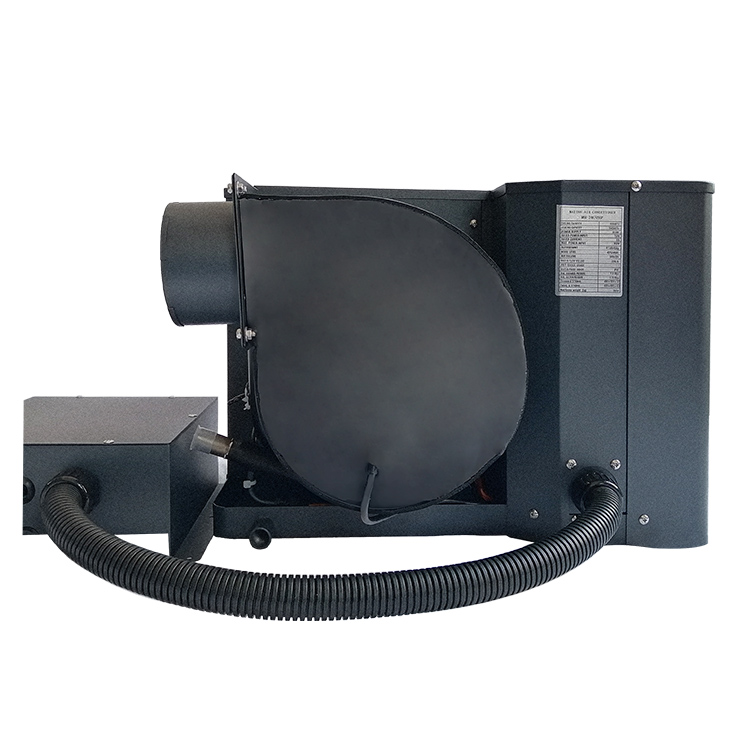
A useful comparison is a permanently installed marine design rather than a supposedly identical portable model. ZhuoliMarine’s principal catalog consists of integrated, self-contained boat and Yacht air conditioners intended for fixed onboard cooling and heating.
Those units package the main refrigeration components together, but they still require dedicated electrical connections and a seawater cooling circuit. An integrated enclosure is not the same as a freestanding appliance that can simply be carried into the cabin.
Know Where Fixed Marine Cooling Differs
Heat rejection marks a major difference between the arrangements. A hose-vented temporary appliance releases heat through an exhaust route, whereas an installed marine system transfers condenser heat to circulating seawater.
Fixed equipment requires space for its machinery, plumbing and cabin airflow system, along with service access. That is a more involved commitment, although it avoids using a temporary exhaust hose as the principal heat-disposal arrangement. The pump, seawater plumbing and air-distribution pieces may need to be supplied separately.
For instance, ZhuoliMarine lists the self-contained MAR-220V/09BP with 9,000 BTU cooling, 10,450 BTU heating, 850 W rated electrical input and a specified 720 L/h seawater flow. It uses single-phase 220V AC at 60 Hz and measures 480 × 330 × 335 mm.
The fixed MAR-24V/12BP operates on 24V DC; its specifications list 12,000 BTU cooling, 1,020 W rated input and 1,080 L/h seawater flow, illustrating how an installed system’s infrastructure varies by model. Neither designation should be used to imply a movable, hose-vented product.
The decisive issue is duration and location of use, not whether one enclosure appears compact. For an occasional dockside stay, portable marine AC may offer flexibility when power, exhaust routing and cabin clearance are suitable.
For repeated cruising, the extra planning associated with a fixed system can be worthwhile if the hull and electrical network support it. The two approaches should be compared against the same cabin conditions rather than against unrelated nameplate figures.
Occasional dockside cooling and regular cruising place different demands on the same cabin. ZhuoliMarine’s AC and DC marine units require seawater-cooled installations rather than temporary exhaust hoses; installation guidance and remote technical support cover the associated connections. A fixed-system feasibility check should assess the vessel’s seawater route, electrical supply and return-air space.
