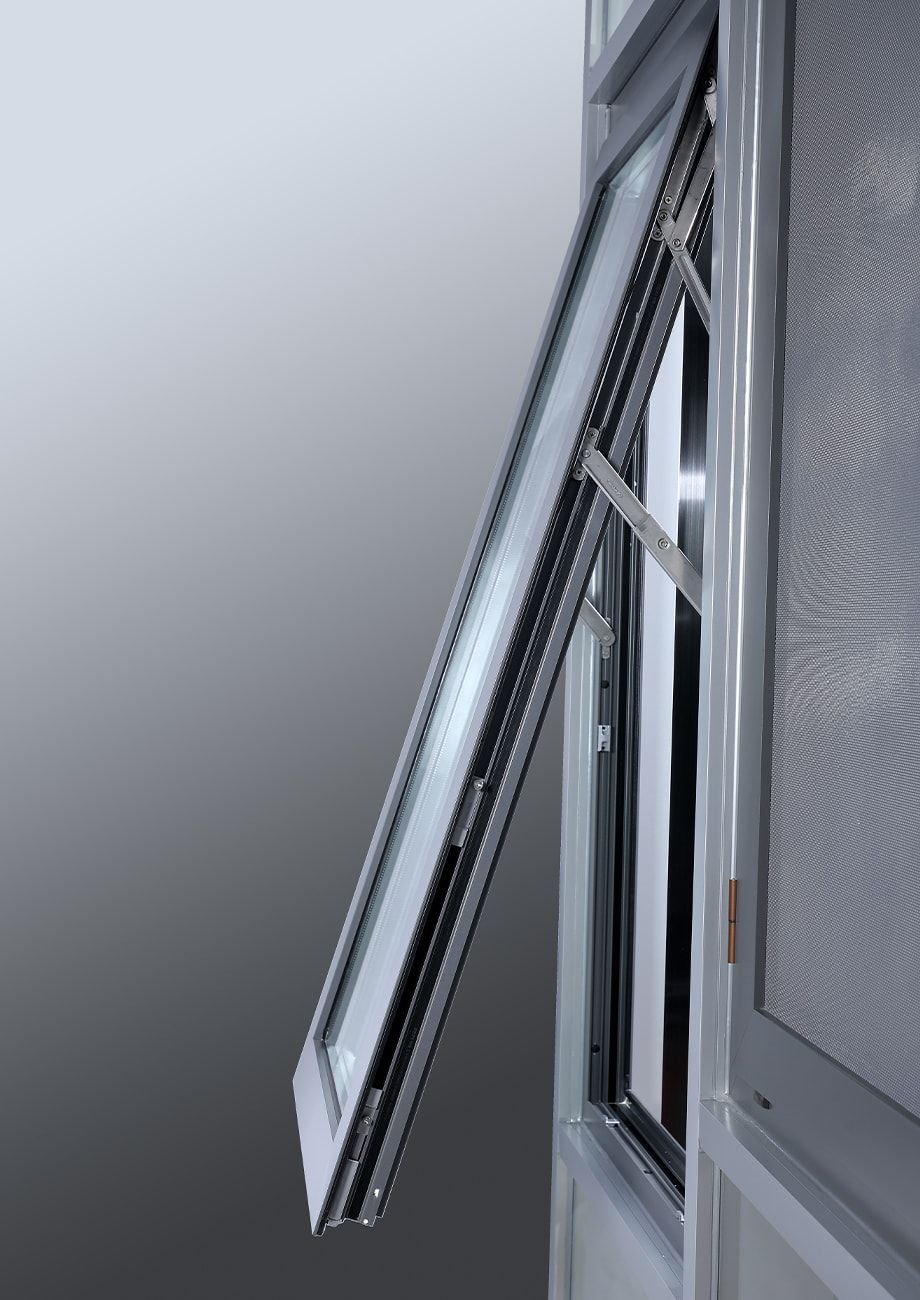
Outward-opening awning windows provide ventilation while allowing the sash to project away from the frame. Their operation depends on several coordinated hardware components, including stays, hinges, locking mechanisms, and operators. Selecting compatible parts is important because each component affects how the sash opens, remains supported, and closes against the frame. CMECH offers an outswing awning window hardware solution that combines these functions within a coordinated system. Understanding the role of each component helps window manufacturers, architects, and building professionals specify suitable hardware for different project requirements.
How Awning Window Hardware Supports Sash Movement
Awning windows are typically hinged along the upper edge, allowing the lower part of the sash to move outward. The hardware must support this movement while helping control the opening position. Unlike a simple handle or isolated hinge, an integrated arrangement coordinates movement, support, and locking.
The main components serve distinct purposes. Hinges guide the sash through its opening arc, stays limit or support its movement, and operators transfer movement from the handle to the relevant mechanism. Locking components secure the sash when the window closes.
CMECH’s outswing awning window hardware solution incorporates a limiting stay, friction hinge, and multipoint lock. These elements address different operating requirements while working within the same hardware system. For fabricators, this coordinated approach provides a basis for evaluating component compatibility before production begins.
Limiting Stays: Controlling the Opening Position
A limiting stay helps control how far a window opens and holds it at the intended opening position when engaged. Its dimensions and connection points need to suit the window profile and sash configuration. An unsuitable stay may restrict movement incorrectly or fail to match the installation requirements.
CMECH offers limiting stays in sizes ranging from 8 to 20 inches for its outswing awning window hardware solution. The stay locks automatically when opened, and its construction uses 304 stainless steel. These characteristics are relevant when evaluating the component for projects where opening control, material selection, and exposure conditions matter.
The correct size should be selected in relation to the window design rather than chosen solely by appearance. Fabricators should confirm the available installation space and the intended operating range before specifying a stay. They should also assess the complete assembly instead of assuming that an individual component determines the performance of the entire window.
Friction Hinges: Matching the Frame and Sash
Friction hinges guide sash movement and provide resistance as the window opens or closes. Their design affects the movement of the sash, the support available during operation, and compatibility with the window profile.
CMECH provides friction hinges in C-groove and K-groove versions for its awning window system. The hinges are made from 304 stainless steel and incorporate a reinforced support arm specified at 3.5 mm thick. The design also includes a hook structure and solid rivets intended to support the connection between components.
These details matter during hardware selection because groove geometry, mounting arrangements, and sash requirements can vary between window systems. Choosing between C-groove and K-groove hardware requires checking the frame profile rather than assuming that the versions are interchangeable.
When reviewing awning window hardware, project teams should also consider the sash dimensions and specified load-bearing range. CMECH lists an applicable sash width and height range of 400–2,000 mm and a maximum load-bearing limit of 130 kg for this solution. These values describe the stated system range; they should not be interpreted as confirmation that every combination of sash dimensions and weight is suitable.
Operators and Multipoint Locking Mechanisms
The operator connects user input with the window’s moving hardware. Depending on the configuration, turning a handle activates a drive mechanism that moves the sash or engages connected locking components. Compatibility between the operator, transmission parts, and locking mechanism is therefore important.
CMECH’s outswing awning window hardware solution includes a multipoint locking mechanism. Its coordinated locking structure is designed to support sealing performance and resistance to wind pressure. When the sash closes, the locking points engage with corresponding components, helping secure the window around the frame.
For manufacturers specifying window awning hardware, the operator and lock should be assessed alongside the hinges and limiting stay. A handle that fits the frame may not operate the existing transmission mechanism, while an incompatible locking arrangement can prevent proper engagement. Checking spindle dimensions, drive connections, and locking-point positions helps reduce these risks during fabrication and installation.
CMECH specifies T-drive lengths of 17, 20, 24, 28, 32, 36, and 40 mm for its outswing awning window system. The listed center distances for the spindle drive gearbox are 22, 25, 30, and 35 mm. These options give fabricators specific dimensions to check when matching the operating mechanism to a window configuration.
Selecting Hardware for Different Project Requirements
Hardware selection should begin with the sash dimensions, weight, frame profile, and intended opening arrangement. These factors help determine which stays, hinges, and drive components are appropriate. Environmental exposure and maintenance access may also influence material and configuration choices.
For example, a large sash may require a different hardware arrangement from a smaller window. However, selecting a component based only on its stated load capacity can overlook the effects of sash geometry, installation quality, and the interaction between components. The complete configuration must remain within the manufacturer’s applicable specifications.
CMECH’s window awning hardware range provides a starting point for evaluating these requirements. Its listed specifications cover sash widths and heights from 400 to 2,000 mm, with a load-bearing limit of up to 130 kg. Before finalizing a specification, window manufacturers should confirm that the intended sash configuration falls within the applicable range and that the selected components are compatible.
For project teams, documenting groove type, drive dimensions, sash measurements, and hardware configuration can simplify purchasing and assembly. This is particularly useful when several window sizes are included in one project, as similar-looking windows may still require different components.
CMECH and Integrated Awning Window Solutions
CMECH develops door and window hardware systems for architectural applications. Its outswing awning window hardware solution brings together limiting stays, friction hinges, and multipoint locking components within a defined system. This makes the product relevant to fabricators and project teams evaluating the relationship between individual hardware parts and the finished window.
The company also distinguishes an overall hardware Solution from an individual product Series. For awning windows, the Solution describes the coordinated system, while specific components perform their respective functions within it. Understanding this distinction helps buyers communicate requirements more clearly when reviewing product configurations.
Further information about the product specifications is available on the CMECH outswing awning window hardware page. Product selection should be based on the relevant application, technical specifications, and frame compatibility rather than assumptions that one hardware configuration suits every outward-opening window.
Conclusion
Stays, hinges, and operators each contribute to the movement and control of outward-opening awning windows. Limiting stays help control opening position, friction hinges guide sash movement, and operators work with locking mechanisms to support secure closure. Selecting compatible components requires attention to frame grooves, drive dimensions, sash measurements, and load-bearing requirements. CMECH’s outswing awning window hardware solution provides defined component options and application ranges for this selection process. By evaluating the complete system before specifying individual parts, window manufacturers and building professionals can make more informed decisions about hardware compatibility and installation.
