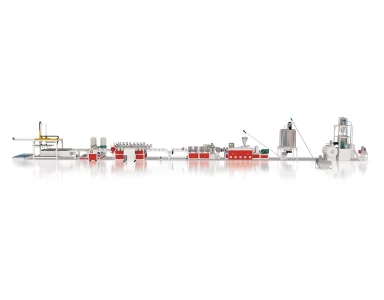
In the industrial sector, the efficiency of a production facility is often defined by how effectively it utilizes its physical footprint. For B2B manufacturers, a bloated floor plan translates to higher utility costs and slower material handling. When integrating a plastic flooring making machine, strategic layout planning is essential to balance high-volume output with a compact, streamlined workflow that maximizes every square meter of the factory floor.
Optimizing the Extrusion Footprint
The primary challenge in a flooring production line is the linear nature of the process, which can often stretch to 25 meters or more in length. To achieve a space-saving layout, modern engineering focuses on modular component integration. By utilizing a “U-shaped” or “L-shaped” configuration instead of a single long straight line, manufacturers can fit high-capacity systems into narrower facilities. This not only saves space but also centralizes the operator’s workspace, allowing a single technician to monitor both the feeding system and the final stacking unit more efficiently.
Space-Saving Components in the Plastic Flooring Making Machine
Technical innovations in auxiliary equipment further contribute to a reduced footprint. For example, integrated hot-cooling mixers and vertical screw loaders minimize the horizontal space required for material preparation. Additionally, the transition from traditional cooling water tanks to compact, high-efficiency cooling bridges and multi-roller haul-off units allows for faster board stabilization in a shorter distance. Automated flipping and stacking systems are also vital; they replace large manual sorting areas with vertical storage solutions, ensuring that finished LVT or SPC boards are neatly organized without encroaching on transit paths.
Customized Layouts by Boyu
Recognizing the diverse architectural constraints of global factories, Boyu excels at providing customized, high-density production solutions. Their PVC foam board extrusion line is designed with a focus on high-output performance. They offer flexible configurations that allow B2B clients to adapt the machinery to their specific workshop dimensions without sacrificing technical precision.
With over 28 years of industry leadership and a 60,000 m² modern manufacturing base, they understand that a “one-size-fits-all” approach does not work for industrial scaling. Their engineers provide comprehensive installation guidance and layout design to ensure that their equipment integrates seamlessly into existing workflows. By choosing their patented extrusion technology, partners can achieve massive daily production while maintaining a clean, safe, and space-efficient manufacturing environment.
