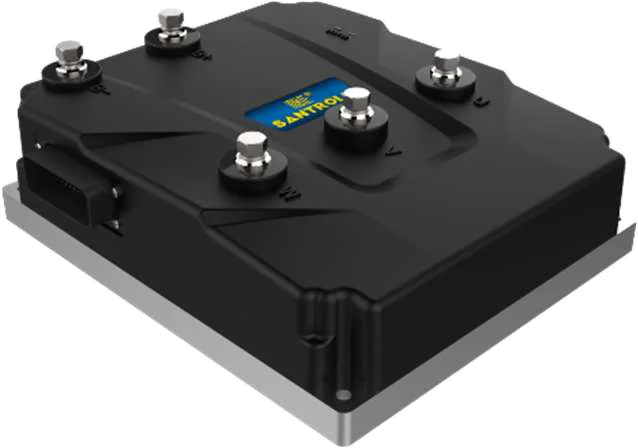
The operational principles of Brushless DC (BLDC) and Permanent Magnet Synchronous (PMSM) motors share similarities, yet their control strategies differ significantly. These distinctions influence performance characteristics like torque smoothness, efficiency, and acoustic noise. Understanding the difference between a bldc motor controller and one designed for a PMSM is crucial for optimal system integration. Santroll engineers motor controller systems for both architectures.
Fundamental Waveform and Commutation Techniques
The primary distinction lies in the shape of the back-electromotive force (back-EMF) and the controlling voltage waveform. A bldc motor controller is designed for motors with a trapezoidal back-EMF. It applies six-step commutation, delivering blocky, trapezoidal current waveforms to the motor phases. In contrast, a PMSM motor controller targets a sinusoidal back-EMF and uses Field-Oriented Control (FOC) to generate smooth, sinusoidal currents.
Torque Delivery and Operational Performance
The commutation method directly impacts torque output. The trapezoidal control from a bldc motor controller produces torque ripple, especially at lower speeds, which can result in vibration and audible noise. The sinusoidal current from a PMSM motor controller creates a constant torque, leading to smoother operation, reduced vibration, and higher efficiency, particularly in applications requiring precise speed control.
Application-Specific Controller Selection
The choice between a bldc motor controller and a PMSM controller often depends on the application’s priorities. The BLDC approach, often less complex to implement, is suitable for applications where cost-effectiveness and high-speed operation are key. The PMSM method, requiring more sophisticated processing in the motor controller, is selected for applications demanding smooth low-speed operation, high efficiency, and minimal acoustic noise.
The control difference fundamentally separates these two motor types in practice. Santroll‘s development of specialized motor controller units, including advanced bldc motor controller designs, acknowledges that application requirements dictate the optimal technological path. The selection is not about superiority, but about aligning the motor’s inherent physics with the most effective control strategy for the task.
