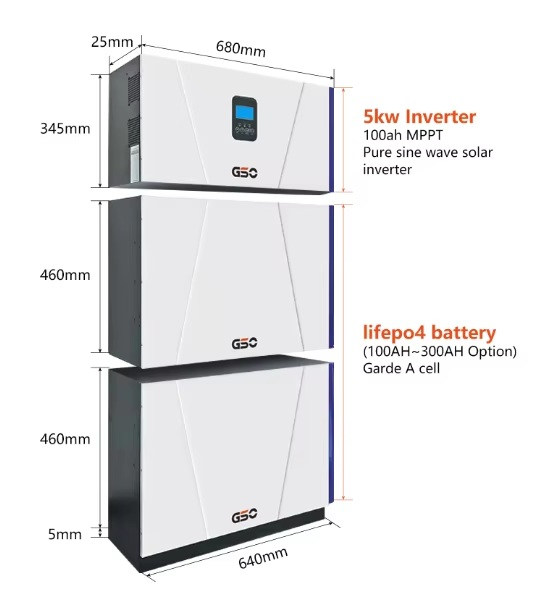
Traditional solar-storage installations can be assembled from several separate components: an inverter, battery modules, a solar charge controller, power-distribution hardware, monitoring equipment, and the wiring needed to connect them. An all in one solar generator takes a different approach by combining several of these functions into a coordinated enclosure or modular stack.
The purpose is not to change the basic flow of solar energy, but to reduce the number of separately selected and wired components. An all in one solar power system can therefore be useful where a project values integrated installation, compact equipment layout, coordinated control, and the possibility of adding battery capacity within the same platform.
What an Integrated Solar-Storage Unit Contains
Integration begins with the functions that every solar-storage system must perform. Solar power has to enter through a charging stage, batteries need managed charging and discharging, stored DC energy must be converted into usable AC output, and protection systems must supervise abnormal conditions.
GSOpower’s GSL Series combines a hybrid inverter, LiFePO4 battery modules, PV charging, MPPT control, power distribution, and BMS functions in one pre-wired stackable machine. In an all in one solar generator, these elements are designed to operate as a single system rather than as separately sourced devices.
The battery section uses REPT/EVE cells and is listed with more than 6,000 cycles and a 10-year life. The product family also carries CE, MSDS, and UN38.3 certifications. DSP control, safety algorithms, multi-layer warning functions, and intelligent BMS monitoring support coordinated operation inside the integrated platform.
How Power Moves Through the System
An integrated design still follows familiar energy-management logic. PV electricity enters through one or more MPPT channels, active loads can be supplied through the inverter, and surplus solar energy can charge the battery modules. Stored energy is later converted back to AC for connected loads when solar production is insufficient or another operating condition requires battery discharge.
The All in One Solar Power System supports three output modes and four charging modes, giving the platform more than one way to prioritize available power sources. APP-based cloud monitoring also provides remote visibility into system status through the intelligent BMS.
Switching performance matters where the system is expected to support loads through changes in power source. GSL models list a typical inverter/bypass switching time of 10 ms, while maximum battery-inverter efficiency is specified at 93%. These figures describe how the integrated system manages the transition and conversion stages rather than simply how much battery capacity is installed.
Power, Battery and PV Specifications Define the Application
The GSL48 family includes 5.5 kW inverter versions paired with 10, 20, or 30 kWh storage, as well as 10 kW inverter versions paired with 10 or 20 kWh storage. The rated AC output is 230 VAC, configurable for 200, 208, 220, or 240 VAC at 50 or 60 Hz, and the output waveform is pure sine wave.
Battery voltage is 48 V. Depending on the configuration, the listed operating range is 42–54.75 V or 44.8–58.4 V, with charge and discharge rates of 0.5C or 1C. These values influence how quickly stored energy can be exchanged with the inverter and how the battery section must be matched to system power.
PV charging uses one or two MPPT channels. Maximum solar-array power is listed at 5,500 W or 5,500 W plus 5,500 W, with an MPPT operating range of 120–450 V and 99.9% tracking efficiency. For an all in one solar generator, these PV input limits are essential because they define how much solar capacity can be connected and how the array must be configured.
Who Benefits Most From an All-in-One Design
The GSL Series is intended for residential and small-commercial applications where integrated equipment and reduced on-site component selection are desirable. A 5.5 kW version can support essential household loads such as refrigerators, lighting, home-office equipment, and washing machines.
The 10 kW version is positioned for larger homes or small businesses with heavier loads such as central air conditioning, electric water heating, and larger kitchen appliances.
An All in One Solar Power System can also simplify installation planning because the inverter, battery, and control hardware are factory wired within the platform. That does not eliminate the need for correct sizing. PV array power, required autonomy, load demand, battery capacity, and permitted inverter output still have to match the application.
Modular stacking provides another practical advantage. Storage capacity can be increased through additional battery modules, so the system does not have to remain fixed at its initial energy capacity if demand later grows.
An integrated solar generator is therefore best understood as a packaging and control strategy rather than a fundamentally different source of energy. It combines the major solar-storage functions into one coordinated architecture while retaining the same need for correct load analysis, PV sizing, battery capacity, and operating-mode selection.
GSOpower‘s GSL platform shows how an all in one solar generator can serve homes and small businesses through pre-wired integration, modular storage, MPPT charging, BMS supervision, and remote monitoring. The practical value of the design comes from matching those integrated capabilities to a site that genuinely benefits from a compact and coordinated solar-storage system.
