Procurement teams navigating capital expenditure approvals frequently encounter a stark pricing variance across global machinery quotes. Low upfront price tags often mask underlying compromises in thermal regulation, semiconductor grade, or transformer stability. High-volume manufacturing plants cannot afford unexpected production halts triggered by premature hardware failure or inconsistent weld nuggets, especially within high-speed automotive and new energy battery assembly lines.
Evaluating manufacturer quotations requires looking past initial invoices to understand the true engineering variables governing equipment pricing. Factory directors must dissect these financial layers carefully before committing capital budgets to large-scale production expansions.
Decoding Initial Capital Outlay Versus True Total Cost of Ownership
Capital allocation models in automotive and battery assembly facilities demand a rigorous examination of lifecycle expenses rather than isolated purchasing costs. Initial equipment invoices typically account for only a fraction of the total financial commitment required over a multi-year operational lifecycle. Inefficient power electronics or unstable current delivery inevitably drive up scrap rates, demanding costly manual reworks across shifts.
Deploying advanced resistance welding solutions alters this dynamic by stabilizing thermal profiles and protecting core production efficiency without unexpected interruptions, preventing costly field recalls or structural failures.
Facilities handling high-alloy metals benefit immediately from robust power architectures that minimize trial-and-error tuning overhead and reduce calibration expenses.
Engineering directors must calculate energy consumption tariffs when assessing transformer efficiency ratings across competing equipment proposals. Inverter-based power architectures draw significantly less continuous current from facility grids, reducing utility overhead during heavy manufacturing runs.
Savings accumulated through optimized electrical efficiency frequently offset initial price differentials within the first operating year of continuous production, thereby improving overall return on investment metrics for corporate management.
Transparent manufacturer pricing models explicitly outline these energy parameters alongside primary hardware procurement costs, empowering plant accountants to forecast operational budgets accurately.
Hardware Architecture and Precision Control Cost Drivers
Manufacturing complexity dictates that microsecond-level current adjustments command higher development investments from equipment builders. Closed-loop feedback controllers equipped with high-speed data acquisition require sophisticated microprocessors and robust secondary sensors.
These advanced electronics prevent subsurface voids and metal expulsion during sensitive multi-layer sheet joining tasks, protecting sensitive subcomponents from catastrophic thermal damage during production.
Consequently, equipment pricing reflects the extensive engineering overhead necessary to guarantee absolute repeatability across millions of industrial cycles without thermal drift.
Mechanical rigidity and force-feedback mechanisms further influence pricing structures by ensuring precise electrode displacement before current initiation. Pneumatic or servo-driven actuation assemblies must withstand millions of high-impact cycles without mechanical drift or alignment loss, guaranteeing structural integrity under heavy mechanical loads.
Integrating robust cooling channels prevents thermal saturation during demanding round-the-clock shift schedules in modern automotive fabrication plants. High-grade materials and precision machining directly elevate baseline manufacturing expenses for builders striving to meet strict industry compliance standards.
Navigating Supply Chain Resiliency and Component Traceability
Global manufacturing disruptions have exposed the hidden vulnerabilities of depending on fragmented supply chains for critical resistance welding hardware. Equipment builders who invest in vertically integrated manufacturing or maintain strategic buffer stocks of proprietary electronic subcomponents insulate their clients from paralyzing lead-time extensions.
When a critical control board fails on an active production line, the true cost of the machine is heavily dictated by how quickly a replacement can be sourced and authenticated. Premium equipment pricing often reflects robust component traceability and redundant sourcing strategies that guarantee rapid spares fulfillment, protecting plant operations from multi-week assembly gridlocks.
Integration Flexibility and Factory Automation Scalability
Modern smart factories demand seamless data interoperability between shop-floor welding controllers and higher-level Manufacturing Execution Systems (MES). Equipment platforms that incorporate open-architecture communication protocols—such as PROFINET, EtherNet/IP, or OPC UA—allow plant engineers to capture real-time weld logs, voltage signatures, and displacement metrics without expensive proprietary middleware gateways.
While controllers equipped with advanced industrial internet of things (IIoT) capabilities carry a higher initial acquisition cost, they eliminate the substantial labor overhead associated with manual quality auditing and paper-based tracking.
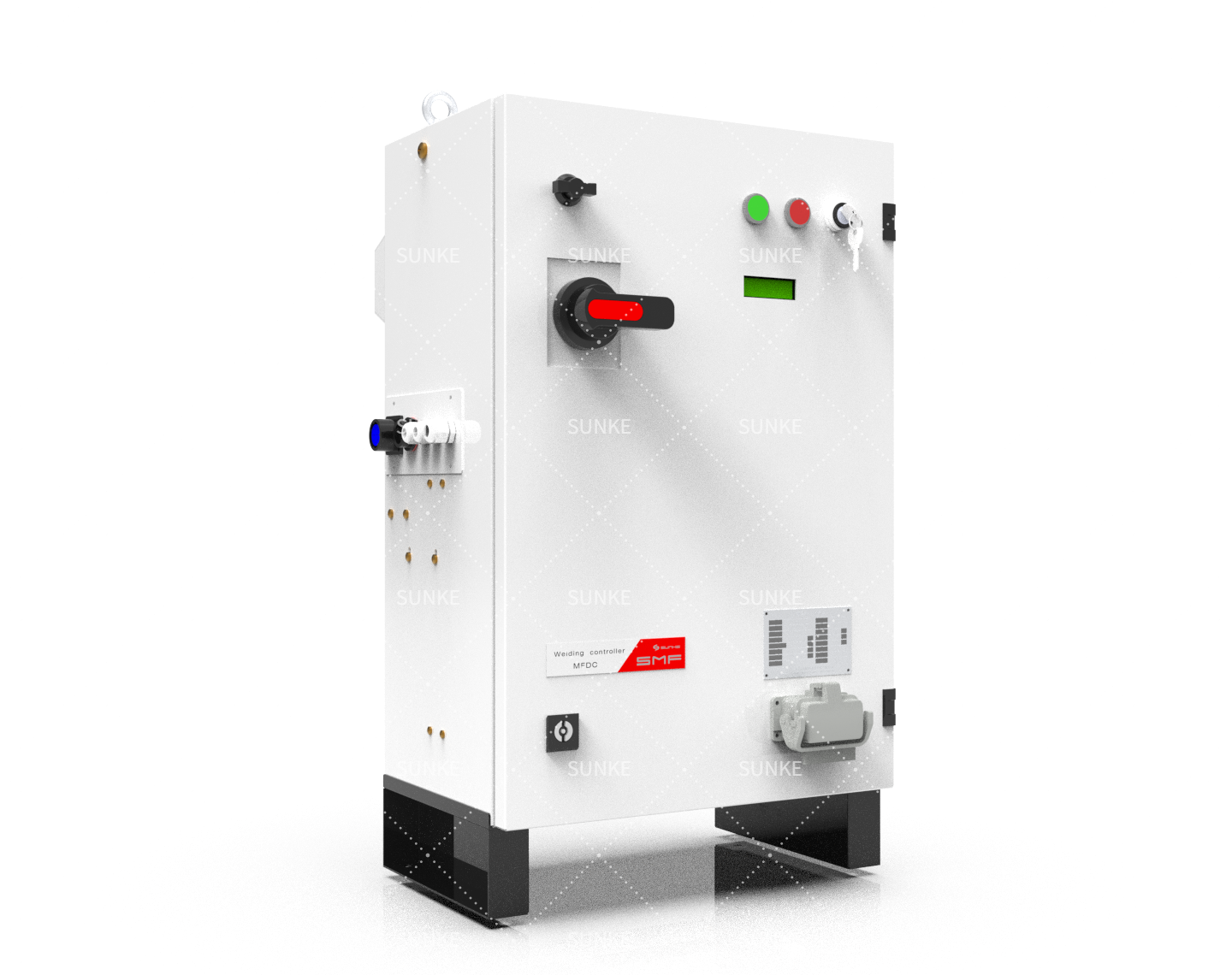
Sunke offers MFDC and MFAC welding controllers for automated and fixture-based welding configurations, giving integrators another factor to examine: whether the welding-control platform can remain suitable as the production architecture changes.
Facilities utilizing scalable hardware ecosystems can seamlessly adapt to shifting vehicle platforms or changing battery cell formats without requiring a complete controller redesign.
Maintenance Overheads, Consumable Wear, and Downtime Risks
Consumable degradation represents a recurring operational expense directly tied to the thermal management capabilities of the power source. Unstable current spikes accelerate copper tip wear, driving up routine maintenance budgets and forcing frequent production line interruptions.
Upgrading aging factory infrastructure to modern resistance welding systems distributes thermal loads evenly across contact points, mitigating unexpected line stoppages that tighten customer delivery windows.
This technological refinement extends routine servicing intervals and preserves facility profit margins.
Unscheduled downtime carries financial penalties that quickly eclipse any initial savings achieved during equipment procurement negotiations. Maintenance teams require intuitive diagnostic interfaces and automated self-calibration tools to identify component drift early. Manufacturers incorporating comprehensive built-in data logging eliminate the need for costly third-party monitoring add-ons.
Clear software licensing terms prevent unexpected operational expenditure spikes after the primary warranty expires, reducing administrative friction and simplifying long-term plant asset management.
Evaluating Manufacturer Pricing and Strategic Value Alignment
Selecting an equipment partner requires assessing technical support responsiveness, spare parts availability, and engineering collaboration depth. They deliver robust industrial power platforms designed specifically to minimize lifecycle expenses while maximizing joint consistency across demanding sectors.
Partnering with experienced manufacturers like Sunke can provide access to resistance welding equipment and technical support, helping production teams manage equipment integration, commissioning, and long-term operational requirements.
Expert application engineering support bridges the gap between raw equipment capabilities and fully optimized plant performance.
Long-term vendor relationships secure preferential access to firmware upgrades, hardware expansions, and specialized operator training programs. Total cost optimization ultimately relies on selecting field-proven hardware platforms designed to survive harsh shop-floor environments.
Facilities integrating reliable resistance welding solutions achieve superior metallurgical outcomes without compromising assembly speed, securing long-term competitive advantage in rapidly evolving industrial markets.
Industrial leadership depends heavily on deploying dependable resistance welding systems backed by transparent manufacturer pricing structures and unwavering technical support.
