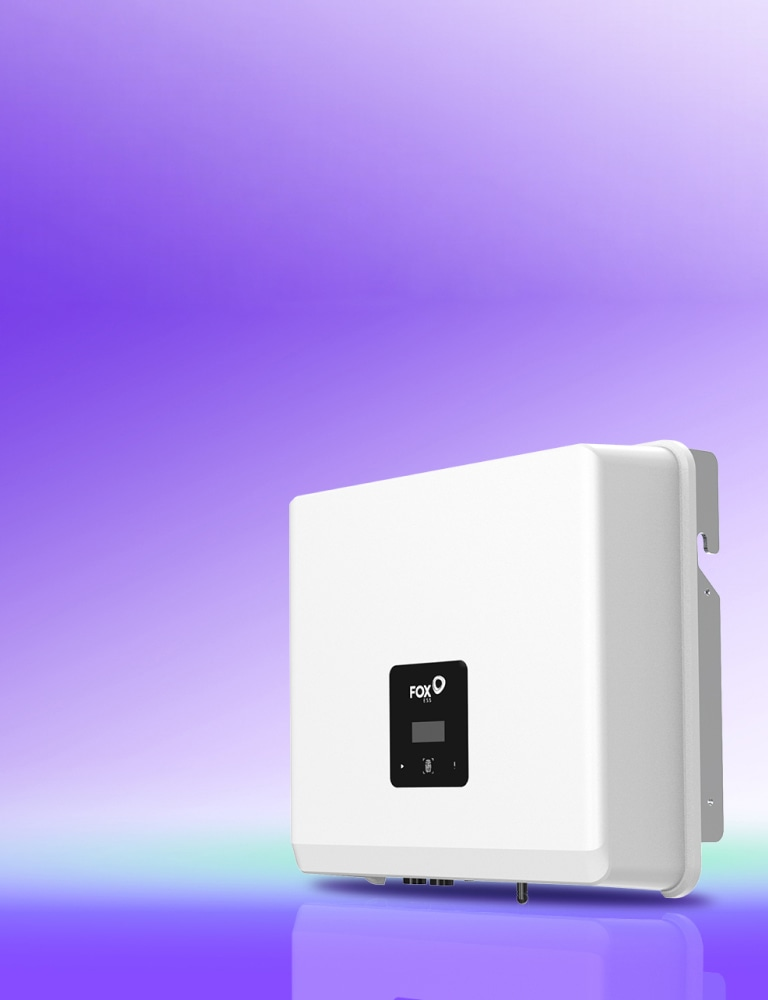
Selecting a PV inverter supplier involves more than comparing a single efficiency figure. Installers and distributors need a portfolio that covers different system sizes, while project owners also need equipment that can be installed efficiently, protected against environmental conditions, and monitored after commissioning.
The supplier’s engineering and manufacturing capabilities matter too, because they influence the ability to maintain a product portfolio over time.
Fox ESS addresses these requirements through a broad inverter range supported by dedicated R&D and manufacturing resources. Its current portfolio spans single-phase residential models through higher-power three-phase units, while the company also provides remote monitoring and technical resources around its products.
A Portfolio That Covers Different Project Scales
One reason Fox ESS stands out as a PV inverter supplier is the range of power classes available from a single product family. The F Series covers 3–6 kW, while the G Series extends from 7–10.5 kW. Three-phase options include the T Series at 3–30 kW and the V Series at 30–75 kW. The R Series extends further to 75–136 kW.
Such breadth gives installers more room to match inverter capacity with project requirements. A residential installation does not necessarily require the same architecture as a larger three-phase PV system, so having multiple ranges can simplify supplier selection across a varied project pipeline.
The portfolio also gives distributors a broader product proposition. Rather than specializing in one narrow power segment, Fox ESS can support different applications through its single-phase and three-phase inverter families. That can be commercially useful for partners serving mixed residential and larger PV projects.
Efficiency Starts With PV Input Management
Efficiency is one of the first technical specifications reviewed when evaluating a PV inverter because conversion losses directly affect how much generated electricity reaches the AC side of the system.
The published specifications list maximum efficiencies of 97.4% for the F Series, 97.8% for the G Series, and 98.6% for both the T Series and T Series G3. The listed ranges also feature low start-up voltage and wide voltage ranges.
Those characteristics give installers useful technical parameters when matching equipment with a PV array. Low start-up voltage can be relevant to system operation under lower available DC voltage, while a wide voltage range provides greater flexibility when evaluating array configurations.
Higher-power V and R Series models add functions aimed at more demanding PV installations. Their published specifications include real-time PV string current sampling and monitoring, allowing string performance analysis and abnormal-condition reporting.
Installation Details Matter at Project Level
A PV inverter can have strong specifications and still create unnecessary work if its installation process is cumbersome. Installer efficiency therefore becomes part of the practical value of the equipment.
The F, G, and T Series are described as supporting flexible configuration and plug-and-play setup. Those characteristics are intended to make installation more straightforward, although actual installation requirements will always depend on the specific model, site, electrical design, and applicable local rules.
The supplier also provides datasheets, user manuals, Quick Install Guides, warranties, and certificates through its online resource center. Having these materials accessible alongside the product portfolio gives installers a direct source for project preparation and technical reference.
Important for a PV inverter provider, this supplementary paperwork is necessary as the installation relationship continues even after the equipment is installed. Commissioning, service, and subsequent system inspections all make use of product information.
Protection and Monitoring Extend the Value of the Inverter
Environmental protection becomes particularly relevant when an inverter is installed outdoors. The F, G, and T Series are listed with IP65 ratings, while the V and R Series carry IP66 ratings. The published descriptions position these ratings as supporting outdoor installation and performance under demanding environmental conditions.
Higher-power models also incorporate additional functions. The V and R Series include AFCI functionality, while their specifications list PID recovery and PV string monitoring. These features address different aspects of system protection, array oversight, and long-term PV operation.
Monitoring extends that visibility beyond the inverter itself. The residential F, G, and T Series can be monitored remotely through a smartphone application or web portal, allowing users to access system information without being physically beside the equipment.
Engineering and Manufacturing Behind the Product
Product specifications provide only part of the supplier picture. Long-term product development requires engineering resources, testing, manufacturing capability, and continued investment.
Fox ESS states that its Wuxi R&D center is supported by hundreds of engineers and technicians working on solar inverter and energy-storage development. Its innovation page also lists operations in more than 90 countries, more than 5,000 employees worldwide, and five R&D centers.
Manufacturing is presented as another part of the company’s operation, with an intelligent production line supporting its product development and delivery model. The combination of R&D and manufacturing gives the company a vertically supported foundation for developing and producing energy technologies.
When evaluating a supplier relationship for the long run, that infrastructure is helpful for distributors and installers. Instead of a focused product operation, it shows that the inverter portfolio is backed by a well-established company.
Why the Supplier Choice Extends Beyond Hardware
A strong PV inverter supplier needs to satisfy several stages of the project lifecycle. Product range determines whether the equipment can fit different installations; efficiency and voltage characteristics influence technical selection; installation features affect field workflows; protection and monitoring support operation after commissioning.
Fox ESS brings those elements together across its inverter portfolio while supporting the products with R&D, manufacturing, documentation, and digital monitoring capabilities.
When distributors and installers compare a PV inverter provider, the resultant proposal is more comprehensive than a single model. The provider is able to meet the needs of various power sectors by offering the necessary organisational infrastructure and technological resources.
That combination makes Fox ESS a relevant choice for partners looking beyond a single inverter specification. The stronger proposition lies in connecting product breadth, installation practicality, system visibility, and engineering capability into one supplier relationship—an approach that can support both today’s PV projects and a growing portfolio of future installations.
