A data center outage is rarely limited to the minutes when servers stop responding. For operators, the financial impact can extend to lost transactions, service-level penalties, emergency repairs, customer disruption, reputational damage, and recovery labor. Uptime Institute’s 2025 outage analysis reports that 54% of surveyed organizations said their most recent significant, serious, or severe outage cost more than $100,000, while one in five reported costs above $1 million.
That makes a data center power quality failure more than an electrical engineering issue. It is a business continuity concern. A useful downtime cost calculation should therefore connect the duration of an incident with the operational and financial consequences that follow.
Why Data Center Power Quality Matters to Business Continuity
Power issues remain the most common cause of serious and severe data center outages, according to Uptime Institute research. Although not every power-quality disturbance produces an outage, electrical instability can increase stress on power infrastructure and sensitive IT equipment.
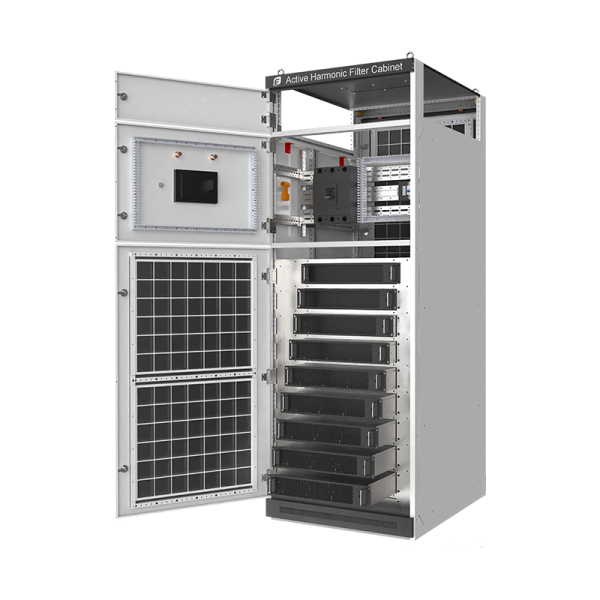
Modern facilities also contain large numbers of switched-mode power supplies, UPS systems, PDUs, and other electronic loads. These loads can contribute harmonic currents and create additional demands on electrical distribution systems. Active harmonic filters are specifically used to mitigate such harmonics and can also support power factor correction.
For operators, the practical question is not simply whether a facility has experienced a failure. It is whether electrical conditions are creating avoidable operational exposure before a visible outage occurs.
A Simple Framework for Calculating Downtime Cost
A data center downtime cost calculator should begin with the revenue and operational value exposed during an interruption. One basic model is:
Downtime cost = direct revenue loss + productivity loss + recovery expense + contractual impact + secondary business losses.
Direct revenue loss can include transactions that cannot be completed while systems are unavailable. For colocation and cloud operators, the calculation may instead begin with affected customer services and contractual obligations.
Recovery costs should include emergency engineering support, replacement components, overtime, diagnostics, and potentially expedited logistics. The longer the incident continues, the more likely secondary effects become significant.
Reputation is harder to quantify, but it should not be ignored. Uptime Institute’s outage research explicitly includes direct, opportunity, and reputation costs when assessing the total financial impact of incidents.
Why Short Power Events Can Still Have Large Consequences
A downtime calculation based only on outage duration can overlook the sensitivity of modern digital infrastructure. A brief electrical disturbance may trigger equipment protection, transfer events, alarms, or unexpected behavior even when a complete facility shutdown does not occur.
This is why response time matters when evaluating a data center power quality solution. Enjoypowers specifies a 5 ms response time for its data center power quality application, targeting the fast-response requirements associated with modern server PSUs and PDU equipment. The company also states a target attainable THDi below 5%.
Such specifications should be evaluated against the facility’s actual electrical measurements, load profile, protection architecture, and design requirements rather than treated as a universal guarantee for every installation.
Turning Electrical Measurements Into Financial Risk
A useful power-quality assessment should connect electrical data with operational consequences. Engineers may examine harmonic distortion, reactive power, power factor, voltage behavior, load characteristics, and equipment operating conditions.
Harmonic mitigation is particularly relevant where large concentrations of electronic loads are present. Eaton, for example, describes active harmonic filters as systems that inject reactive currents to cancel harmonic currents while supporting power factor requirements. Its solutions specifically include data center switched-mode power supply loads among applicable uses.
For a facility manager, this information can help establish whether corrective equipment is addressing a measured problem rather than adding capacity without a clear technical basis.
How a Data Center Power Quality Solution Fits the Architecture
Enjoypowers approaches data center power quality through active harmonic filtering and reactive power compensation. Its published architecture identifies two common installation points: PDU-level deployment for individual data halls or rack rows, and facility-level deployment at the utility intake or main bus.
The company also states that N+1 redundancy is supported for Tier III and Tier IV applications. Its example describes a cabinet with 12 modules operating at full rated capacity with 11 modules active, leaving one module for redundancy. The company further states that failed modules can be detected while remaining modules redistribute the load.
For business buyers, these architectural details matter because power-quality equipment must be considered alongside availability targets, maintenance procedures, expansion plans, and the facility’s broader electrical design.
From Downtime Cost to Preventive Investment
The purpose of a downtime cost calculator is not to produce an alarming number. It is to create a rational basis for preventive investment.
If a facility estimates that a serious incident could expose hundreds of thousands of dollars in combined operational and business losses, even a relatively small electrical problem deserves structured investigation. Uptime Institute’s latest research reinforces this principle: power issues remain the leading cause of serious and severe data center outages, while outage costs remain substantial.
Enjoypowers positions its data center offering around the same risk-management logic, combining active harmonic filtering, reactive power compensation, fast response, a target THDi below 5%, and supported N+1 redundancy.
Building a More Complete Data Center Risk Calculation
For data center owners, operators, consultants, and electrical contractors, the strongest calculation combines three perspectives: electrical performance, availability risk, and financial exposure.
Electrical measurements reveal what is happening. Reliability analysis estimates how an event could affect operations. Financial modeling translates that exposure into business terms. Together, these elements provide a more useful basis for deciding whether monitoring, system optimization, or a dedicated data center power quality solution is appropriate. The result is a shift from asking, “How much does power-quality equipment cost?” to a more relevant business question: “What level of financial risk is the facility willing to accept if electrical conditions contribute to an interruption?”
