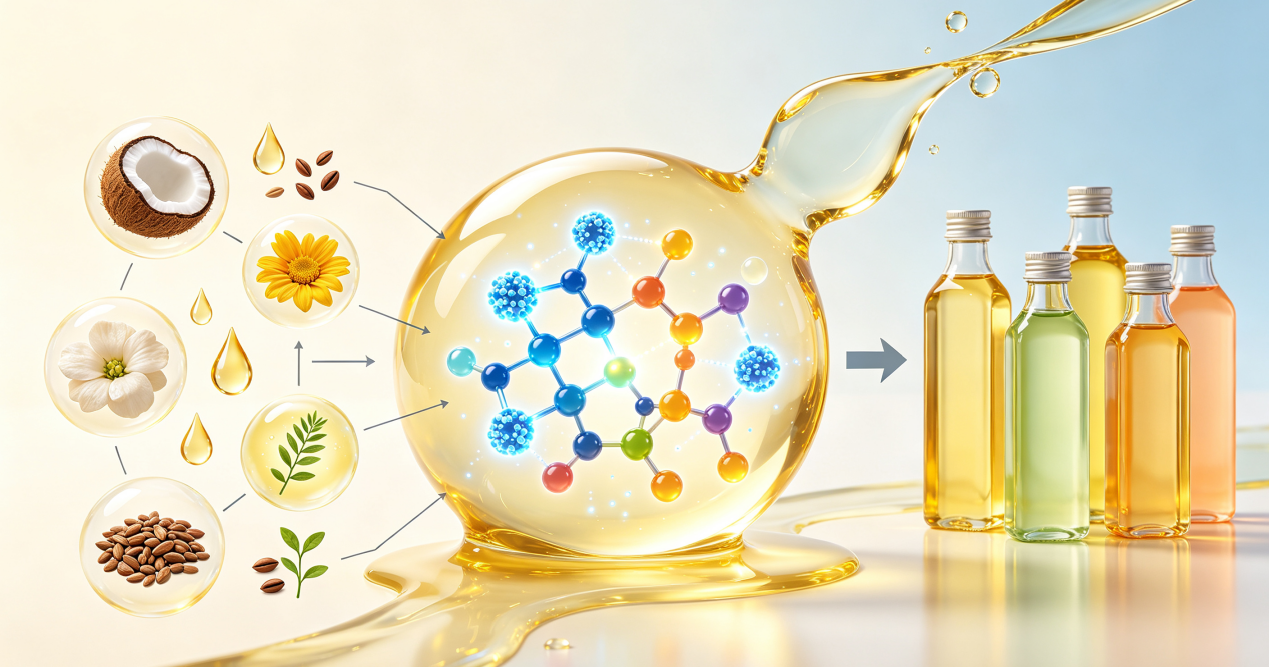
The global fats and oils industry is undergoing a fundamental transformation. Consumer demand for healthier, more functional products has created unprecedented opportunities for lipid innovation. At the heart of this transformation lies enzymatic interesterification—a versatile platform technology that enables the production of custom-structured lipids with precisely tailored nutritional and functional properties. This article explores how this technology is opening new possibilities across multiple product categories.
The Platform Concept: Enzymatic Interesterification as a Versatile Tool
Enzymatic interesterification utilizes lipases—biological catalysts with specific positional selectivity—to rearrange fatty acids on the glycerol backbone of triglycerides. Unlike chemical interesterification, which produces random fatty acid distribution, enzymatic methods enable precise control over the final product structure.
This precision creates a platform for customization: by selecting appropriate substrate oils, enzymes, and reaction conditions, manufacturers can produce structured lipids optimized for specific applications and health outcomes.
Key Advantages of Enzymatic Interesterification
Zero Trans-Fat Production: Unlike partial hydrogenation, enzymatic interesterification modifies lipid structure without generating harmful trans fatty acids.
Nutritional Enhancement: Positional specificity allows the incorporation of beneficial fatty acids—DHA, EPA, α-linolenic acid (ALA), medium-chain fatty acids—into stable carrier oils at precise positions on the glycerol backbone.
Functional Property Optimization: By controlling fatty acid composition and distribution, manufacturers can tailor melting profiles, crystallization behavior, and texture characteristics to meet specific application requirements.
Clean Label Appeal: The enzymatic process is perceived by consumers as more natural than chemical modification, supporting clean-label marketing claims.
A Portfolio of Structured Lipid Products
The versatility of enzymatic interesterification enables production across multiple product categories:
Medium- and Long-Chain Triglycerides (MLCT)
By combining medium-chain triglyceride sources—such as coconut oil or palm kernel oil—with long-chain oils—such as high-oleic sunflower oil, soybean oil, or canola oil—manufacturers can produce MLCT with tailored fatty acid profiles.
Customization Example: Coconut oil + high-oleic sunflower oil yields an MLCT rich in lauric acid (C12) and oleic acid (C18:1), balancing rapid energy metabolism with cardiovascular benefits.
ALA-Enriched MLCT
For omega-3 applications, α-linolenic acid-rich oils (flaxseed, perilla) can be combined with medium-chain triglyceride sources. Recent research has demonstrated the successful synthesis of ALA-MLCT through enzymatic interesterification, achieving 76.59% MLCT content and 45.03% ALA-MLCT under optimized conditions.
Customization Example: Coconut oil + flaxseed oil yields a structured lipid combining medium-chain fatty acids with ALA, delivering both rapid energy and omega-3 benefits. The resulting product also demonstrates 2.44 times the oxidative stability of simple physical blends.
DHA-Enriched Structured Lipids
DHA sources—including algal oil and fish oil—can be incorporated into stable carrier oils through enzymatic interesterification. Research has demonstrated DHA incorporation rates exceeding 39% in camellia seed oil matrices.
Customization Example: Camellia seed oil + algal DHA yields a structured lipid combining oleic acid stability with DHA neurodevelopmental benefits.
Specialty Fats for Food Applications
Enzymatic interesterification enables the production of zero-trans plastic fats for bakery and confectionery applications. Research has successfully produced ALA and medium-chain fatty acid-enriched plastic fats with tailored solid fat content and melting profiles.
Customization Example: Highly hydrogenated soybean oil + Cinnamomum camphora seed oil (rich in medium-chain fatty acids) + perilla oil (rich in ALA) can be formulated into a zero-trans plastic fat with enhanced nutritional properties.
Additional Example: Camphor seed oil and palm stearin, when enzymatically interesterified, produce structured lipids suitable for margarine applications, with improved nutritional profiles compared to conventional margarine fats.
Industrial Production Considerations
Enzyme Selection and Immobilization
The choice of lipase is critical. Available enzymes include:
- Lipozyme RM IM: Effective for acidolysis reactions and DHA incorporation
- Lipozyme TL IM: Suitable for interesterification and ALA-MLCT synthesis
- Novozym 435: Versatile for various structured lipid applications
Immobilized enzymes offer the advantage of reusability, reducing production costs. Fixed-bed reactor systems represent the most promising industrial configuration for continuous enzymatic interesterification.
Process Optimization Factors
Key parameters include:
- Substrate ratio: Determines final fatty acid composition
- Reaction temperature: Affects both reaction rate and enzyme stability
- Enzyme loading: Must balance conversion efficiency against cost
- Reaction time: Maximizes incorporation while minimizing degradation
Purification and Quality Control
Product purification typically involves:
- Removal of free fatty acids (through deacidification)
- Decolorization and deodorization for final product quality
- Analysis of fatty acid composition and triglyceride structure for quality assurance
Market Trends and Commercial Opportunities
The structured lipid market is experiencing robust growth. Global demand for functional oils is driven by:
- Rising health consciousness and interest in metabolic health
- Growing demand for sports nutrition and performance products
- Expanding infant formula and specialized nutrition markets
- Consumer preference for clean-label, sustainable ingredients
In China, the functional oil sector is at an early stage of rapid growth. Industry analysts project significant expansion over the next 5-10 years, with domestic producers increasingly competing with international suppliers.
Partnering for Structured Lipid Success
The successful implementation of structured lipid production requires integrated expertise in enzyme technology, lipid chemistry, process engineering, and quality assurance. At Ocean, we provide comprehensive solutions for functional lipid manufacturing, from process design to full-scale production implementation. Our expertise in edible oil processing and specialty lipid production positions us to support clients across the full range of structured lipid applications. Together, we can transform your vision for functional oils into commercial reality.
