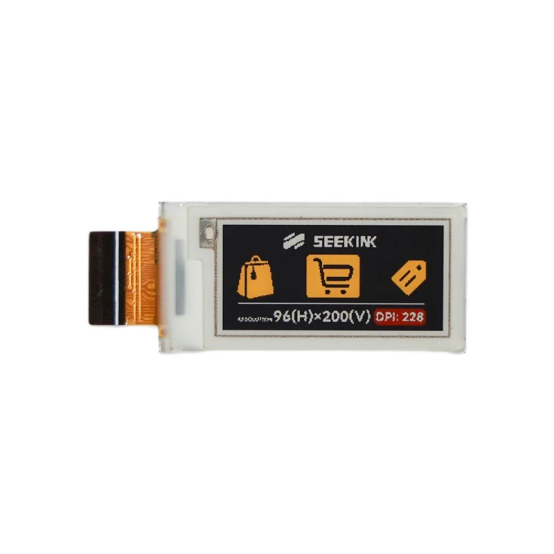
E-paper products are usually seen as finished devices, but many of them begin with a display component that must be selected, integrated, and driven correctly. An EPD display is an electrophoretic display element designed to show readable visual information with paper-like qualities and low power needs for static content.
An e ink module usually includes the display and related interface requirements that allow a product developer to build it into readers, signs, badges, labels, or other devices.
SEEKINK’s official module category page helps explain this idea by grouping modules according to color configuration and screen size, including black-and-white, black-white-red, black-white-red-yellow, and full-color options across a range of compact and large-format sizes.
The same official material connects modules with e-readers, notepads, name badges, phone cases, photo frames, transportation signs, workplace displays, and advertising screens. This makes the module the foundation rather than the final user experience. This distinction helps readers understand why module information is usually more technical than the language used for a finished consumer product.
Display Type and Color Selection
The first task is choosing the display type. An EPD display may be monochrome, tri-color, four-color, or full color, and each choice should be linked to what the product needs to show. A small label may only require black-and-white text, while a retail sign, photo frame, or decorative wall may need more colors.
SEEKINK’s official category includes examples such as 0.97-inch tri-color and four-color modules, a 1.54-inch flexible module, an 8.58-inch four-color display, a 13.3-inch colored display using Spectra 6, and circular Prism modules. An e ink module should not be chosen only because it appears attractive in a catalog.
Refresh behavior, color needs, viewing distance, power design, and enclosure limits all affect whether the module can serve the final product. A rigorous explanation should therefore present module selection as an engineering decision rather than a simple screen-size choice. Color selection should also reflect how often the information changes and whether the content is text, icons, signage, or image-based material.
Size, Form Factor, and Product Use
Module size shapes the entire device around it. An EPD display below 3 inches can fit compact badges, tags, trackers, or small labels, while larger sizes may support notepads, readers, signage, and public information boards. SEEKINK organizes the category in size groups that help buyers narrow their selection before comparing exact models.
The company’s official pages also show flexible, circular, and large rectangular possibilities, which indicates that e-paper can serve more than one physical design. An e ink module for a wearable product will face different demands from a module used in a desk nameplate or an outdoor sign. The design must consider viewing angle, casing, connector position, update method, and environmental protection.
These factors explain why the module should be considered early in product planning, before the rest of the housing, battery, and software layout is fixed. Mechanical planning becomes especially important when the display must fit a circular badge, a flexible tag, or a large public information surface.
Integration with Broader E-Paper Applications
The third point is how modules connect to finished solutions. An EPD display may appear simple to the end user, but it depends on drivers, control boards, power management, waveforms, and update logic. SEEKINK’s wider site places e-paper in advertising, consumer electronics, transportation, workplace, healthcare, and other fields, which shows how a similar display principle can support different tasks.
An e ink module used in a name badge may need mobile or cloud updating, while a module used in a photo frame may require stronger color expression and image handling. A transportation sign may focus on sunlight readability and efficient updates. The product category therefore should be understood as a toolbox.
Different modules offer different balances of size, color, flexibility, and integration complexity, and a suitable choice is the one that fits the final operating environment. Integration also requires attention to testing, because a module that looks suitable in isolation may behave differently inside a complete device.
E-ink modules are the building blocks behind many e-paper products. An EPD display supplies the visible surface that makes text, images, labels, or signs readable with a paper-like appearance. An e ink module turns that display into a component that can be selected for a specific size, color set, shape, and application.
SEEKINK’s official module category supports this explanation by listing varied color technologies, multiple size groups, flexible and circular formats, and examples that connect modules to readers, notepads, badges, phone cases, photo frames, Prism walls, and dynamic signage. A careful article should avoid presenting modules as interchangeable parts.
Their value depends on how well the display characteristics, driving requirements, and product environment match.
When those factors are considered early, the module can support a device that is readable, efficient, and suited to its intended use. In that way, module choice becomes a design decision that affects readability, battery planning, enclosure structure, and the user’s final experience. It also helps readers see why official module data is essential before making decisions about downstream products.
SEEKINK offers a useful reference point when size, color technology, interface requirements, and end-product placement are considered together.
