Modern electronics repair demands precision across tightly toleranced enclosures and miniature fasteners. Everyday wear, mixed fastener standards, and improvised tools jeopardize repair quality, causing costly delays. Hardware manufacturers like Jakemy engineer multi-component kits to eliminate recurring shop-floor frustrations before minor component damage escalates into catastrophic failure.
Technicians often tolerate degrading tools until stripped screw heads or cracked casings disrupt turnaround times. Recognizing early indicators of inadequate equipment allows repair operations to modernize proactively. Upgrading bench equipment and relying on a dedicated Jakemy tool set restore efficiency and precision to workstations handling delicate consumer tech.
Persistent Fastener Stripping and Bit Cam-Out
Screwdriver bits that slip during torque application indicate dimensional mismatch or tip fatigue. Budget drivers or worn bits fail to seat deeply into micro-recesses, concentrating rotational force along fastener edges instead of drive walls. Each slipping incident rounds fastener slots, turning routine maintenance into high-risk recovery.
Stripped screw heads typically stem from using generalized drivers on specialized fasteners like Torx security or micro-cross drives. Inadequate tip engagement damages delicate hardware, forcing technicians to deploy destructive screw extractors. Working with rounded bits risks irreparable thread stripping inside sensitive internal frames.
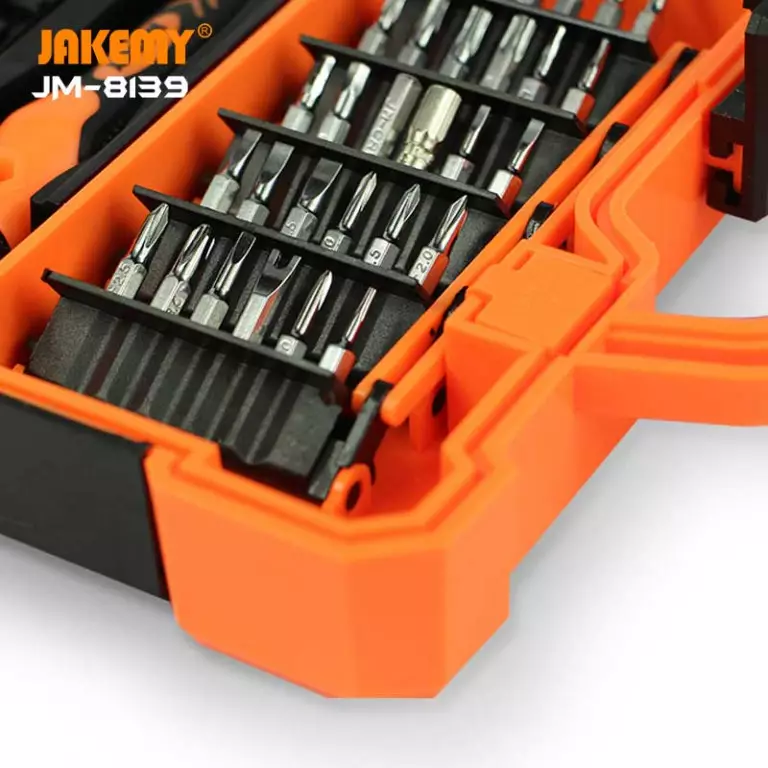
Upgrading to precision-machined bits with accurate dimensional tolerances eliminates premature cam-out. Selecting an integrated kit like the Jakemy JM-8139 provides immediate access to calibrated drive profiles designed to seat firmly within micro-fasteners. Stable mechanical engagement preserves mounting posts and speeds up daily device maintenance.
Cosmetic Damage from Improvised Enclosure Prying
Cracked glass displays, dented bezels, and snapped clips reveal an urgent need for dedicated opening instruments. Technicians working without specialized spudgers or separation picks frequently resort to utility blades or scrapers to overcome perimeter adhesives. These improvised implements concentrate pressure on fragile glass edges, scratching coatings and puncturing internal batteries.
Adhesive-sealed housings require controlled, distributed separation force rather than blunt leverage. Using makeshift prying implements deforms housing seams, leaving visible tool marks that compromise dust seals. Modern consumer electronics demand non-marring pry tools engineered from flexible polymers and specialized roller wheels that glide safely through adhesive beads.
Professional disassembly requires purpose-built accessories that decouple housings without gouging delicate framing. Employing opening tools, suction cups, and flexible spudgers supplied within a complete Jakemy tool set prevents surface marring during tough housing splits. Proper prying accessories safeguard external aesthetics while ensuring internal ribbon cables remain unharmed throughout teardowns.
Assembly Halts Caused by Missing Proprietary Drive Profiles
Encountering uncommon fasteners mid-repair brings entire service workflows to an abrupt standstill. Modern electronic devices rarely feature uniform screws, often combining standard Phillips heads with Pentalobe, Tri-point, or standoff fasteners within a single device. Reaching for a non-matching bit to force an unusual screw invites immediate fastener deformation.
Consumer electronics manufacturers regularly adopt proprietary screw standards to prevent unauthorized internal access. Independent repair shops relying on basic bit selections must pause work to source missing profiles, dragging out completion timelines. To address fastener diversity, Jakemy incorporates high-density drive arrays into unified service kits, ensuring technicians remain equipped for multi-generation hardware.
Comprehensive bit coverage prevents unexpected workshop downtime when novel device models arrive on the bench. Securing an all-in-one platform where the Jakemy JM-8139 bridges the gap across mixed-drive assemblies guarantees immediate tool compatibility. Technicians seamlessly transition between disparate screw geometries without pausing to search for individual drivers.
Lost Bench Time from Disorganized, Scattered Drivers
Misplacing critical drive bits amidst cluttered repair trays diminishes workstation productivity. Technicians juggling loose drivers or digging through mismatched boxes waste valuable minutes identifying correct bit sizes. Over an entire work week, time spent hunting for missing tools translates directly into reduced bench throughput and delayed deliveries.
Unorganized workspaces increase the probability of losing miniature components during complex disassemblies. When individual bits lack assigned storage bays, damaged or dull components remain mixed with operational tools, causing repeated selection errors. Disorganization creates cognitive fatigue, leading to assembly mistakes and misplaced hardware screws.
Consolidating disparate hand tools into an indexed storage enclosure restores order to active repair stations. Moving toward a centralized platform by standardizing on an integrated Jakemy tool set eliminates workbench clutter through labeled bit slots and dedicated tool bays. Technicians verify kit completeness before closing down work areas, preventing tool loss.
Dropped Micro-Fasteners and Weak Magnetic Retention
Small electronic screws slipping off driver tips during insertion create severe assembly delays and short circuits. When a miniature fastener falls deep into a multilayer motherboard housing, technicians must dismantle installed sub-assemblies to retrieve it. Loose screws trapped inside active assemblies cause devastating electrical shorts if energized during diagnostic testing.
Losing magnetic coupling between the driver bit and the fastener head signals worn or unmagnetized equipment. Budget precision drivers often lack sufficient magnetic strength to stabilize microscopic screws through deep screw wells. Without steady magnetic retention, blind fastener alignment becomes frustrating, inaccurate, and time-consuming.
Reliable magnetic bit holders combined with flexible extension shafts resolve vertical installations inside crowded enclosures. Utilizing the strong magnetic retention and extension adapters found throughout the Jakemy JM-8139 ensures steady control over micro-screws in hard-to-reach cavities. Technicians position tiny fasteners with pinpoint accuracy, avoiding dropped parts and lost bench time.
Achieving Bench Consistency with Consolidated Tooling
Maintaining high-throughput repair standards requires equipment that eliminates operational friction throughout daily disassembly. Recognizing these recurring shop-floor warnings empowers technicians to replace fragmented collections with unified hardware. Standardizing workstations around precision solutions from Jakemy establishes consistent service throughput while guarding delicate electronics against accidental handling damage.
Diagnostic efficiency ultimately depends on having the correct drive geometry, non-marring prying instruments, and magnetic retention immediately accessible. Upgrading to an all-inclusive toolkit accelerates turnaround times and elevates professional repair consistency.
