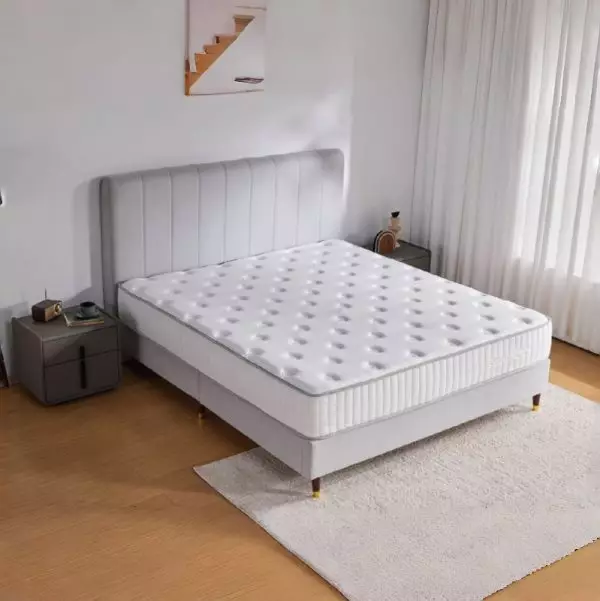
Compression, customization, and wholesale are often discussed as separate mattress trends. In practice, they answer different questions. Compression concerns the physical volume of a shipped product; customization concerns what is built; wholesale concerns how repeated orders are organized and supplied. A buyer can use all three, but one trend does not automatically make the others suitable. The useful analysis starts by asking which part of a business each direction changes.
No forecast is needed to see why the combination attracts attention. Product differentiation can create more specifications, while international distribution puts pressure on carton size and warehouse space. Bulk ordering asks whether those designs can be made consistently. A mattress manufacturer has to connect product engineering, packing, and repeat production before these ideas form a workable program.
Compression Changes the Logistics Equation
Vacuum compression and roll packing reduce the volume occupied by a suitable mattress during transport. A smaller package can change container use, storage layout, and handling. Carton volume falls while the approved finished size remains the reference. The design must recover after unpacking, and its components must be appropriate for the chosen compression method. Damage or poor recovery can erase the shipping advantage, even after the packed volume falls.
The volume gain needs checking against the whole delivery route. Carton strength, protection, stacking, warehouse dwell time, and opening instructions affect what arrives and how it is presented. A mattress supplier can provide model-specific packing dimensions and explain how the mattress is checked after compression. Dividing container capacity by one carton volume is not a reliable loading plan without an actual arrangement.
Suisin Furniture includes compressed mattresses in its product mix and describes vacuum compression and roll packing as ways to reduce logistics volume. That is a concrete capability rather than a claim that every mattress should be compressed. Product construction and distribution conditions determine whether it belongs in a particular wholesale program.
Customization Creates Product Decisions
A private-label brief can reach beyond logos and cartons into the mattress’s support and comfort systems. These are not equivalent changes. A new label mainly affects presentation; a different spring unit or comfort layer can change the product’s response and require a fresh sample. A mattress manufacturer should record which version is approved before a buyer treats a customized line as ready for volume production.
The benefit of customization is a fit to a sales channel or customer group. The cost is greater specification discipline. A range with several firmness levels, covers, and sizes needs model codes, sample references, and artwork control. If those elements are missing, variety creates ordering errors rather than a useful assortment. The purpose of each variation should be evident in the product plan.
Suisin Furniture states that buyers can request those kinds of product and presentation changes. Hotel designs sit beside hybrids, spring mattresses, memory foam, and compressed models. A broad catalog offers several starting points, while the approved construction and intended use of each proposed model determine which options belong in an actual order.
Wholesale Depends on Repeatability
Wholesale supply is more than a lower unit price at a higher quantity. Replenishment requires stable specifications, clear minimum quantities, an agreed inspection approach, and a delivery plan that suits the buyer’s inventory cycle. A mattress supplier with several construction types still needs to show how a selected model moves from sample to recurring bulk order.
Suisin Furniture describes sample requests, bulk production, quality control, international shipping, and export support through the same manufacturing organization. Those services can simplify coordination when responsibilities and milestones are clear. A buyer may still need to ask how mixed models are ordered, how changes affect lead time, and how a later shipment is checked against the first approved version.
The three directions interact in practical ways. More customized designs can increase the number of cartons and labels in a warehouse. Compression may offset volume for some models but cannot simplify the underlying version control. Wholesale magnifies small specification mistakes because they are repeated across many units. Evaluating these interactions is more useful than treating each trend as a fashionable feature.
These relationships also affect financial planning. A smaller package may reduce volume, but customized construction can change material usage and sampling work. The buyer needs a quotation for the model and a loading plan for its actual cartons before assigning savings. Wholesale terms likewise depend on the proposed mix and quantity.
If a company changes three variables at once, it becomes difficult to tell which one produced a different cost or customer response. A staged trial can hold the product specification steady while testing packaging, or keep the packing method steady while testing a new comfort design.
Read the Trends Through an Order
An actual order provides the test. Which product is being customized, can its construction be packed as intended, and can the same version be supplied again? A mattress manufacturer that answers those questions with samples, specifications, and a workable shipment plan makes the trend combination operational. Compression addresses space, customization addresses market fit, and wholesale addresses continuity; none substitutes for the others.
