Modern LED displays are no longer limited to flat rectangular video walls. Retail stores, exhibition venues, corporate lobbies, and live events increasingly use customized screen configurations to create distinctive visual experiences. Understanding the terminology behind these solutions helps buyers compare products, communicate with manufacturers, and select the right technology for their projects.
- What Is a Custom LED Display?
A custom LED display is a screen system configured to meet specific requirements for dimensions, resolution, shape, installation, or application. Unlike a standard display with fixed dimensions, a customized solution can accommodate unusual architectural spaces, specialized content requirements, and different viewing conditions.
Customization may involve several elements:
Screen dimensions: Cabinet combinations determine the overall width, height, and aspect ratio.
Pixel pitch: The distance between neighboring pixels influences image detail and viewing distance.
Cabinet structure: Different cabinet sizes and mounting methods support different installation layouts.
Display geometry: Flat walls, curved surfaces, corners, and creative shapes can require different structural approaches.
For commercial buyers, a custom LED display should be designed around the installation environment rather than appearance alone. Maintenance access, structural support, power requirements, and content compatibility are equally important considerations.
- Flexible LED Display, Pixel Pitch, and Refresh Rate Explained
A flexible LED display uses display modules or structural components designed to accommodate curved or non-flat configurations. However, flexibility can mean different things. Some products use physically bendable modules, while modular cabinet systems create curves by arranging rigid panels at specified angles. These approaches should not be treated as interchangeable.
Pixel pitch is another essential term. Measured in millimeters, it describes the distance between the centers of adjacent pixels. A smaller pitch generally provides higher pixel density and finer image detail, making it useful for close-viewing environments such as showrooms and corporate meeting spaces. Larger pitches may be suitable for displays viewed from greater distances.
Refresh rate, measured in hertz (Hz), indicates how frequently the display updates its image. A higher refresh rate can help reduce visible flicker and improve camera performance, although actual results also depend on processing equipment, camera settings, and other display characteristics.
Buyers evaluating a flexible LED display should therefore examine more than its ability to form curves. Pixel pitch, refresh rate, brightness, viewing angle, and mechanical limitations all affect whether the solution suits the intended application.
- How Modular Design Supports Custom LED Display Projects
Modular construction allows manufacturers to combine standardized components into different screen configurations. It can simplify transportation, installation, and replacement of individual sections while providing more freedom in overall screen design.
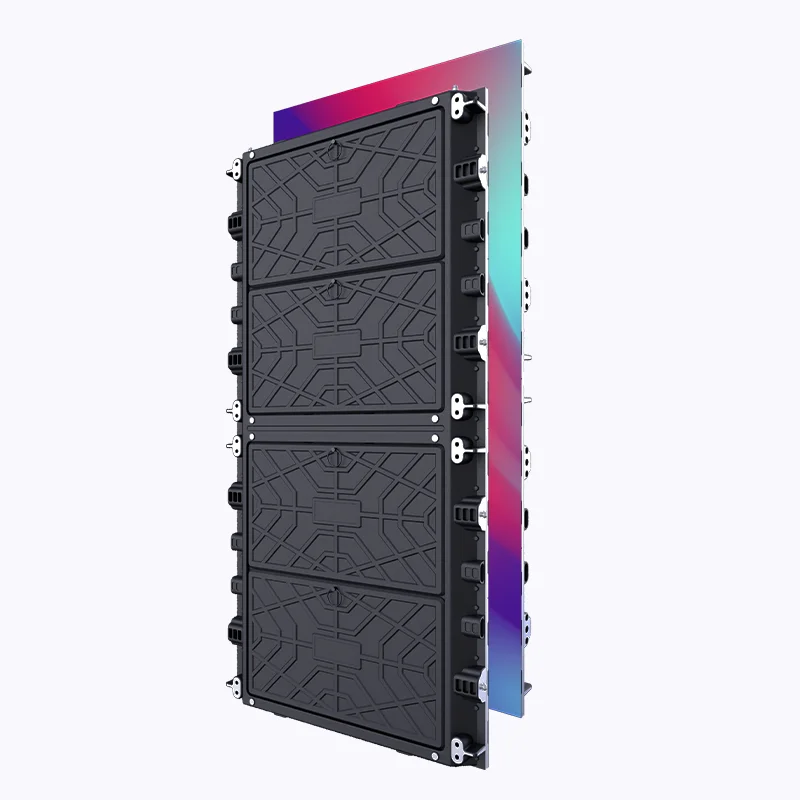
Coblinks, a professional LED display manufacturer based in Shenzhen, China, offers its MC Series for fine-pitch indoor display applications. According to the company’s published specifications, the series includes pixel pitches from 1.25 mm to 3.91 mm and four cabinet dimensions: 500 × 1,000 mm, 500 × 500 mm, 500 × 250 mm, and 250 × 500 mm.
These cabinet sizes can be mixed to create different layouts. The MC Series also supports concave and convex configurations, rotation, and front-and-rear maintenance. Its published specifications list a refresh rate of at least 3,840 Hz, viewing angles of 160° horizontally and vertically, and brightness ranging from 600 to 800 cd/m² depending on the model.
For buyers planning a custom LED display, these features provide practical options for adapting screen dimensions and geometry to a particular venue. They also demonstrate why modular curved configurations should be distinguished from displays that rely on physically bendable panels.
- Choosing the Right Display for Different Applications
The most suitable display configuration depends on the installation environment, viewing conditions, and intended application.
In retail environments, curved screens can wrap around architectural columns or create distinctive product displays. Museums and exhibition spaces may use non-flat configurations to support immersive storytelling. Corporate lobbies often prioritize clean installation, visual consistency, and integration with the surrounding architecture.
For live events, designers may favor creative shapes that complement stage structures. However, rental applications also require attention to assembly speed, cabinet handling, and transportation requirements.
When comparing a flexible LED display with a conventional modular system, buyers should confirm the minimum permitted curve radius, supported angles, cabinet compatibility, and installation method. They should also verify whether the proposed configuration requires additional structural support.
Coblinks provides display options for commercial installations and creative applications, allowing project planners to review technical specifications before selecting a configuration. Its MC Series may be relevant when a project requires multiple cabinet sizes and curved modular layouts rather than continuously bendable panels.
Conclusion
Understanding terms such as custom LED display, flexible LED display, pixel pitch, refresh rate, and modular design helps buyers make better-informed decisions. These concepts describe different aspects of a screen, from image quality to physical configuration, and should be evaluated together.
By reviewing installation requirements alongside published specifications, buyers can determine which technology best fits their space, audience, and budget. Coblinks’ MC Series provides one example of how modular cabinet sizes and creative configurations can support customized indoor LED display projects.
