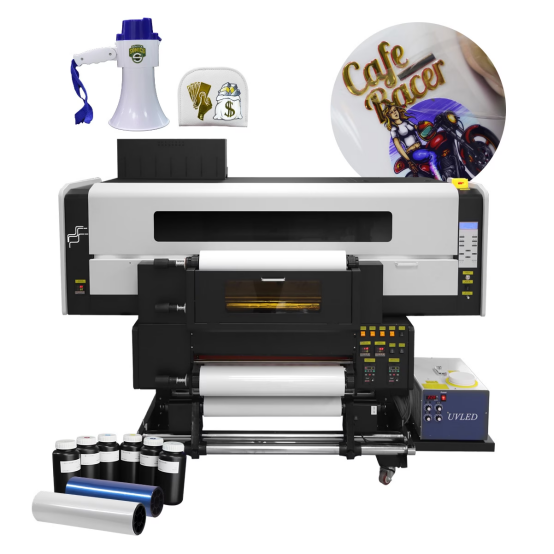
The commercial print landscape undergoes significant technical shifts as customization demands fluctuate across global business sectors. Industrial operations increasingly look toward specialized ultraviolet film transfer systems to bypass conventional decoration bottlenecks on rigid, irregular substrates. Anticipating operational and mechanical trends helps purchasing departments allocate capital efficiently over the coming fiscal periods.
Integration of Multi Stage Automated Workflows
Industrial manufacturing facilities continually seek strategies to compress production schedules and lower manual labor overhead. Future developments point heavily toward the widespread adoption of completely consolidated processing units. A modern UV DTF printing machine natively combines ink deposition, metallic foil stamping, waste matrix stripping, and lamination inside one automated system.
Consolidating these separate mechanical steps into a single continuous process reduces material handling errors significantly. This structural synergy ensures clean transfers while increasing overall throughput capacity for commercial print houses. Eliminating secondary external processing machinery optimizes workshop floor utilization and streamlines factory management.
Evolution of Intelligent Microprocessor Control Systems
Navigating complex equipment parameters traditionally required highly specialized operators to manage physical carriage alignments and ink behaviors manually. Technical projections indicate that industrial equipment will increasingly implement simplified, single-touch digital user interfaces. Incorporating large, responsive touchscreens allows floor technicians to initialize complex multi-layer print runs using pre-programmed commands.
One-button smart production configurations lower the technical barriers associated with daily machine setups. Automated self-calibration protocols manage ink density profiles and carriage speeds dynamically to maintain identical quality standards across varying shifts. These integrated hardware control advancements minimize manual setup waste while stabilizing daily factory yields.
Technical Advancements in Substrate Tracking and Stability
Sustaining high droplet placement accuracy during fast mechanical cycles requires premium structural stabilization mechanisms. Next-generation platforms prevent film shifts by utilizing high-efficiency vacuum suction platforms to secure thin carrier media flat against the bed. This flat presentation prevents physical head strikes and maintains sharp text definition.
Furthermore, implementing automated film peeling mechanisms guarantees smooth separation without tearing delicate, freshly cured adhesive layers. Incorporating physical printhead anti-collision sensors protects expensive nozzle arrays from sudden edge lifting on curled transfer films. These combined physical safeguards maximize overall component longevity while minimizing unexpected maintenance downtime.
Innovations in Energy Efficient Curing Frameworks
Achieving excellent chemical scratch resistance requires optimizing the ultraviolet wavelengths emitted during the cross-linking phase. Industrial machinery relies on specialized air-cooled UV lamp arrays to solidify polymer inks instantly without adding heavy water-cooling infrastructure. This simplified thermal architecture reduces total machinery weight while maintaining highly consistent energy output profiles.
Optimized curing is closely supported by intelligent heated base plates that regulate film temperatures before ink impact. Controlling baseline thermal properties improves the initial chemical bonding between the ink drops and the foil transfer adhesives. Proper temperature management prevents fluid bleeding, ensuring that applied decorations endure severe weather wear.
Analyzing Compact Equipment Profiles for Sizable Facilities
While broad industrial setups suit mass manufacturing pipelines, regional print centers frequently require highly efficient compact platforms. Equipment developers like Xinflying balance space constraints with industrial-grade outputs by creating optimized mid-sized machinery. The 420ST model represents this balanced approach, providing an accessible footprint with full inline processing.
Deploying optimized mid-sized hardware allows commercial firms to execute specialized boutique orders alongside large contract runs. Utilizing professional components within a smaller frame enables flexible business scaling without expanding physical real estate requirements. This strategic sizing trend helps small-to-medium enterprises maximize their regional capital efficiency.
Managing Hydrodynamics and Long Term Ink Supply Security
Sustaining continuous contract production demands reliable ink delivery systems that prevent nozzle dropouts during extensive print shifts. Commercial machinery relies on large-capacity ink reservoirs integrated with automated stirring systems to keep heavy titanium dioxide pigments suspended uniformly. Active agitation prevents fluid separation, protecting print lines from unexpected color shifting.
Integrated early-warning alert networks provide real-time updates regarding internal fluid levels, preventing sudden empty lines mid-process. Maintaining constant internal ink pressure protects fine nozzles from drawing in destructive micro-air bubbles during operation. These structural fluid controls ensure completely uniform output quality across extensive manufacturing batches.
Strategic Software Integration and Color Mapping
The final projection involves deeper integration of advanced raster image processor (RIP) software directly with internal control boards. Modern software bundles optimize aggregate ink utilization values by applying precise variable-droplet algorithms across complex gradient paths. Accurate digital mapping prevents media oversaturation while maintaining vibrant color saturation levels.
Professional software presets allow production managers to replicate precise brand colors accurately on distinct transfer film batches. This digital synchronization reduces initial test-proofing waste during large enterprise contract setups. Investing in robust software infrastructure remains essential for maintaining predictable multi-year operational cost profiles.
Conclusion
Adapting to upcoming digital transfer trends requires examining workflow automation, digital control layouts, and advanced stabilization engineering. Commercial buyers must balance upfront equipment acquisitions against long-term operational efficiency gains to optimize capital returns.
Utilizing robust configurations from trusted industrial suppliers like Xinflying allows print houses to ensure reliable manufacturing continuity. Deploying advanced UV DTF printer networks secures steady market growth through versatile substrate decoration.
